

Spider Veins (telangiectasiae)Spider veins (telangiectasiae) are tiny red or purple veins that can be seen on the face, legs (upper thighs to feet) and occasionally chest, back and abdomen. They are on the surface of the skin and can appear as single lines or connected blue veins resembling tree branches or star bursts.
They can arise due to family genetic traits, as an offshoot of varicose veins, from trauma or previous varicose vein surgery. They are more common in women probably due to hormonal fluctuations. |
Treatment Options
|
Microsclerotherapy.
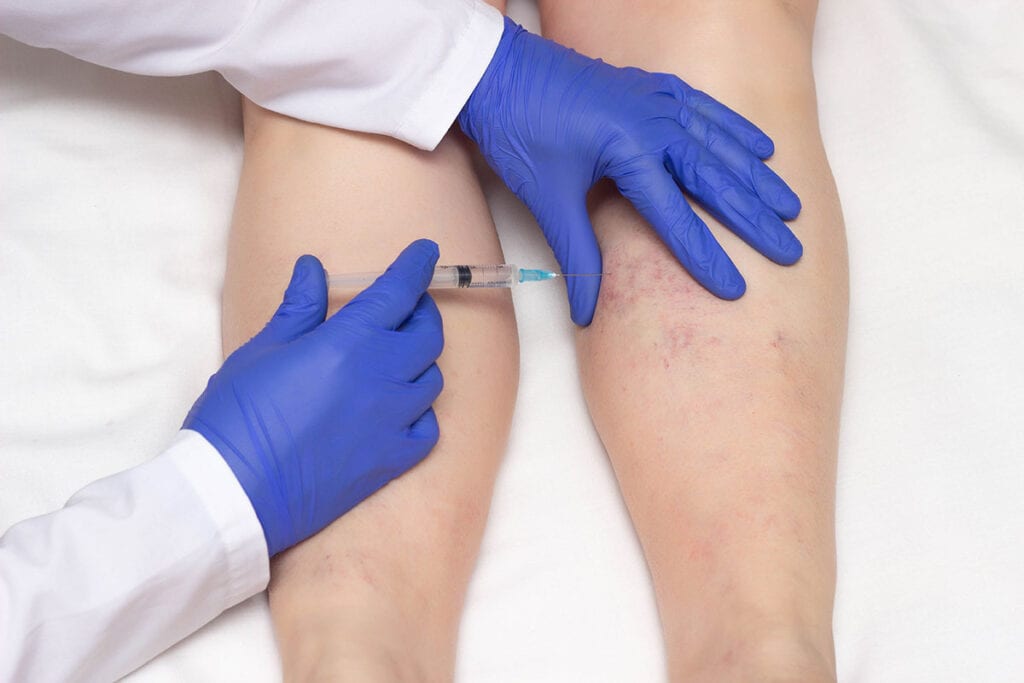
Microsclerotherapy is considered by most Phlebologists (vein experts) to be the best form of treatment of spider veins of the legs, and in some instances, the face and trunk. Microsclerotherapy makes use of a chemical agent called a sclerosant, to destroy the vein wall, thereby causing the veins to shut down. A very fine needle is inserted into the vessels and small amounts of solution are injected at several sites. Once the veins have shut down, blood no longer flows through them and they become firm and discoloured. The body’s defence mechanism treats them as a bruise. Gradual re-absorption takes place and over time the veins fade away.
|
Microsclerotherapy - Side Effects.
These are usually minimal and of a limited nature. The majority will settle with time. They include: Bruising. Most patients will get at least a mild degree of bruising. This will usually disappear at the same rate as other bruising. The treated veins can become darker, and in some cases these may remain dark for several months. Hyperpigmentation (Brown Staining). Usually due to iron deposits from old blood leaching out into surrounding tissues. This staining may take some months to fade, (rarely more than a year). Draining the pockets of old blood can significantly reduce the incidence of hyperpigmentation. Phlebitis. Probably the most common side effect. This is a localised painful inflammation of the treated vein that settles with anti–inflammatories and compression stockings. Itching. Occasionally mild transient itching may occur following treatment. Migraine. Occasionally treatment can precipitate a transient migraine like reaction – usually only in those individuals who are prone to migraine attacks. Ulcers. Allergic Reaction. Infection. |
|
IPL and Vascular Lasers.
IPL (intense pulsed light) and vascular lasers use light energy to destroy spider veins. This is an alternative to microsclerotherapy. IPL is very effective on tiny spider veins, blush areas, spider Naevi and hereditary telangiectatic matting (sock like distribution of masses of tiny vessels over ankle and foot). |
IPL and Vascular Lasers - Side Effects.
Healing. There is always the slight possibility of developing a crust or blister. This is superficial, and rarely results in any scarring. A crust or blister is treated like sunburn or any other blister and may take from five to ten days to heal. Slight itchiness may be felt in the healing area. Pigment changes. The treated areas will probably heal without any pigmentation changes. However there is always the slight chance that hyper-pigmentation (darker) or hypo-pigmentation (lighter) areas may occur. These are generally temporary and will fade within one to six months. Sun exposure must be avoided three to four weeks prior to and post therapy, as exposure to the sun may intensify hyper-pigmentation. In very rare cases, the change of pigment may last longer or be permanent. Scarring. Is very rare and it is important to follow all the post treatment instructions carefully in order to prevent infection. Excessive Swelling. Swelling may occur immediately after treatment, especially after nose or cheek treatment. This is temporary and usually subsides within hours or occasionally may take a few days. Cold compresses or a hydrocortisone preparation or tablets may reduce swelling. Fragile Skin. Treated skin should be touched gently for a few days. It should not be rubbed vigorously and when applying makeup pat gently. Makeup can be applied immediately after treatment as long as the skin is not broken. If that occurs you may be given some antibiotic cream to apply. Skin may be pink in this area for up to six weeks . Bruising. Very rarely a blue-purple bruise (purpura) may appear on the treated area. It may last from five to fifteen days. As the bruise fades there may be brown discolouration of the skin, which generally fades over one to three months. |
Book A ConsultationThe cost of this procedure varies according to the areas that require treatment and whether the area is treated alone or in conjunction with other areas. (This is most common).
To book a consultation with one of our doctors (fees apply) please Contact Us through our enquiry form or by phoning Vein & Skin Clinic on 0800 639 968. |