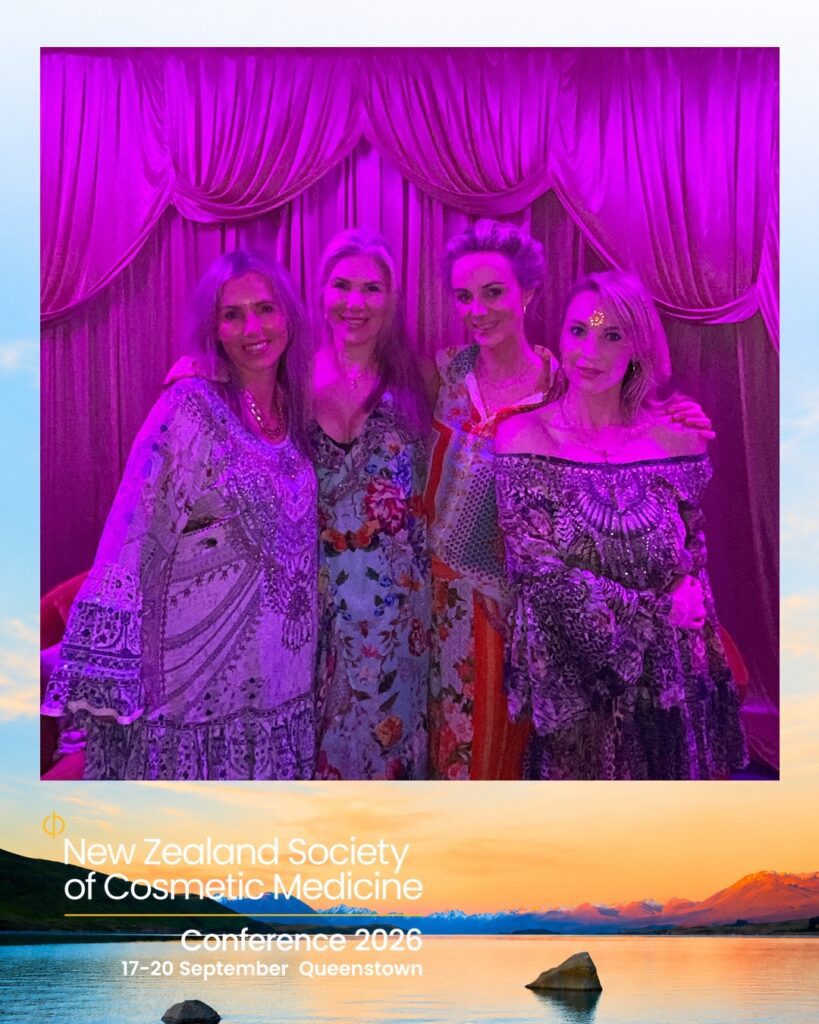
This September, our team travelled to beautiful Queenstown for the annual New Zealand Society of Cosmetic Medicine conference — and for me personally, it was a particularly special one.
While Vein & Skin has a long history with the NZSCM, this was actually my first conference.
My parents, Dr Henryk Poczwa and Bernadette, have been part of New Zealand’s cosmetic medicine community since its early days, so I grew up alongside an industry that has changed enormously. Being there now as Director of Vein & Skin Aesthetics, alongside my parents, my sister and members of our team, felt a little like coming full circle.
It was also wonderful to see Dad recognised with an honorary award — a very proud moment for our family and for Vein & Skin.
Cosmetic medicine is changing
One message came through again and again during the conference:
The future of cosmetic medicine is not about changing the way you look. It’s about preserving, restoring and supporting what is already yours.
Anyone who has watched aesthetic trends over the last 20 years will recognise how much they have changed.
There was a time when cosmetic treatments were heavily focused on adding volume — bigger lips, fuller cheeks and dramatic transformations. Social media and filters arguably pushed this aesthetic even further.
Today, there is a significant movement towards something much more subtle.
Patients increasingly want to look healthy, rested and like themselves.
That means the conversation is moving away from simply “filling” the face and towards skin quality, collagen stimulation, biostimulation and regenerative approaches.
Rather than asking, “What can we add?”, we are increasingly asking:
“How can we encourage the skin and underlying tissues to function better?”
Collagen, elastin and regenerative aesthetics
As we age, collagen production and skin quality gradually decline. Sun exposure, hormonal changes and other lifestyle and biological factors contribute to those changes.
This is where many modern aesthetic treatments come in.
Technologies such as radiofrequency, microneedling and fractional lasers create carefully controlled stimulation within the skin, triggering repair and remodelling processes. Injectable biostimulators work differently, but with a similar philosophy: encouraging the body’s own tissue response rather than simply relying on added volume.
It is why treatments such as Sculptra and Radiesse, skin boosters, RF microneedling, fractional resurfacing and collagen-induction treatments have become such an important part of modern cosmetic medicine.
And it was very clear at this year’s conference that this field is continuing to evolve rapidly.
GLP-1s, menopause and the changing face of ageing
One of the biggest topics of the conference was something that extends far beyond cosmetic medicine: the enormous growth in GLP-1 medications used for weight management.
Significant weight loss can be life-changing. But particularly with rapid or substantial weight loss, some people notice changes in facial volume and skin laxity that make them feel they suddenly look older.
Social media has rather unflatteringly nicknamed this “Ozempic face.”
The important message from the conference wasn’t that weight loss is a problem — quite the opposite. It was that aesthetic medicine needs to understand the changing needs of these patients.
The same applies during perimenopause and menopause, when changes in hormones can affect skin hydration, elasticity and collagen.
For some patients, these changes overlap.
Supporting patients through the whole weight-loss journey
One particularly exciting outcome of the conference is that our OG, Dr Poczwa, has come home inspired too!
With GLP-1 medications such as Wegovy® becoming an increasingly important part of medically supported weight management, Dr Poczwa is getting behind consulting and prescribing Wegovy for appropriate patients at Vein & Skin.
For us, this fits beautifully with the bigger message we took from the conference: we want to look after the whole patient, not simply treat what we see on the outside.
That means supporting appropriate patients through healthy, medically supervised weight loss, while also having honest conversations from the beginning about some of the changes that can accompany significant weight loss — including changes to facial volume, skin laxity and overall skin quality.
Rather than waiting until someone has lost weight and then saying, “What happened to my face?”, we can discuss those possibilities at the beginning of their journey, manage expectations and monitor changes along the way.
And because we have medical, injectable, laser and skin expertise within the same clinic, we can take a genuinely integrated approach. Where appropriate, that might mean simply monitoring the skin; for others it could involve skincare, collagen-stimulating treatments, energy-based devices, skin boosters or biostimulators as their weight changes.
The goal isn’t to prevent the face from ageing or changing — it’s to help our patients become healthier while still feeling confident in the person looking back at them in the mirror.
That is why we are increasingly looking at treatment plans that combine skin health, energy-based devices, biostimulators, skin boosters and appropriate home skincare rather than simply reaching for traditional filler.
One treatment we’re particularly interested in introducing to Vein & Skin is Sunekos, especially for delicate areas such as the under-eye and neck. We’ll have much more to share about this as our team completes the appropriate training and assessment.
A more scientific approach to your skin
Another major takeaway from the conference was the importance of being able to measure what we’re doing.
And this brings me to some very exciting news.
OBSERV is coming to Vein & Skin
We’ve invested in new OBSERV skin-analysis technology.
This will allow us to photograph and assess the skin in a consistent environment and then repeat those images throughout a patient’s treatment journey.
Instead of simply saying, “Your skin looks better,” we want to be able to track change much more objectively.
It will also form part of a new approach to our consultations. We want more time to understand two fundamental things:
What are your expectations? And what is your motivation?
From there, we can assess the skin, discuss what’s realistically achievable and develop a treatment plan specifically for that individual.
Not everybody needs injectables. Not everybody needs a laser. And not everybody needs an aggressive treatment.
Sometimes the answer might be microneedling, exosomes and excellent skincare. For someone else it may involve IPL, RF microneedling, fractional resurfacing or biostimulation.
The important thing is choosing the right treatment for the right person.
And then I bought a new machine…
Possibly my most exciting — and certainly my biggest! — decision in Queenstown was investing in our newest technology from Venus.
One of the gaps I’ve wanted to fill at Vein & Skin has been a comfortable, non-surgical treatment specifically focused on skin tightening, including areas of the body where laxity can be particularly frustrating.
Radiofrequency technology allows us to deliver controlled energy into the tissues to stimulate collagen remodelling and progressively improve the appearance of lax skin.
We’ll have both facial and body treatment capabilities, and we’re developing protocols that make these treatments feel less like a medical procedure and more like an enjoyable part of looking after yourself.
Treatments will start from approximately $350, depending on the area and treatment plan, with courses generally recommended for optimal results.
And there’s another exciting addition coming with it…
TriBella
TriBella combines three complementary technologies within one treatment protocol, addressing multiple aspects of facial rejuvenation.
Rather than focusing on one concern, it combines treatment for elements such as pigmentation and photodamage, skin texture and firmness.
Our team will be completing comprehensive training before we launch it, and I’ll also be travelling to Australia for further advanced training.
There will be plenty more to come on this.
Coming home inspired
After several very full days of lectures, demonstrations, conversations and networking — and perhaps not quite enough sleep — I came home absolutely exhausted, with virtually no voice left, but incredibly inspired.
One of the greatest privileges was simply talking to other doctors, nurses, practitioners, clinic owners and industry experts from around New Zealand and Australia.
You learn so much when you’re surrounded by people who are equally passionate about this industry.
It also reminded me what an extraordinary history Vein & Skin has.
We’ve been part of this medical and aesthetic community for decades. Seeing people approach me to tell me they knew Dad, hearing stories about the early years, and then standing there as the next generation of our family business was incredibly special.
We have always been medically led.
But medicine changes. Technology changes. Our understanding of ageing changes.
And our responsibility is to keep learning with it.
So we’re coming home from Queenstown with new knowledge, new technology, new ideas and an enormous amount of enthusiasm for what’s next.
Thank you to the New Zealand Society of Cosmetic Medicine for an exceptional conference, and to everyone who shared their knowledge so generously.
We’ll see you next year.
Angelique Hopkins
Director & Laser Practitioner
Vein & Skin Aesthetics
Wellington